Transformative Design
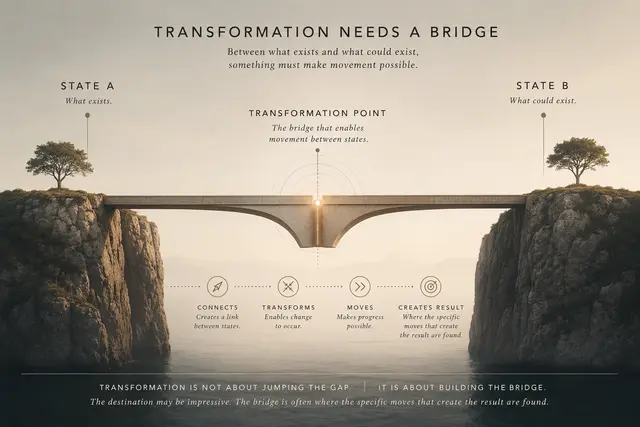
State A → TRANSFORMATION POINT → State B
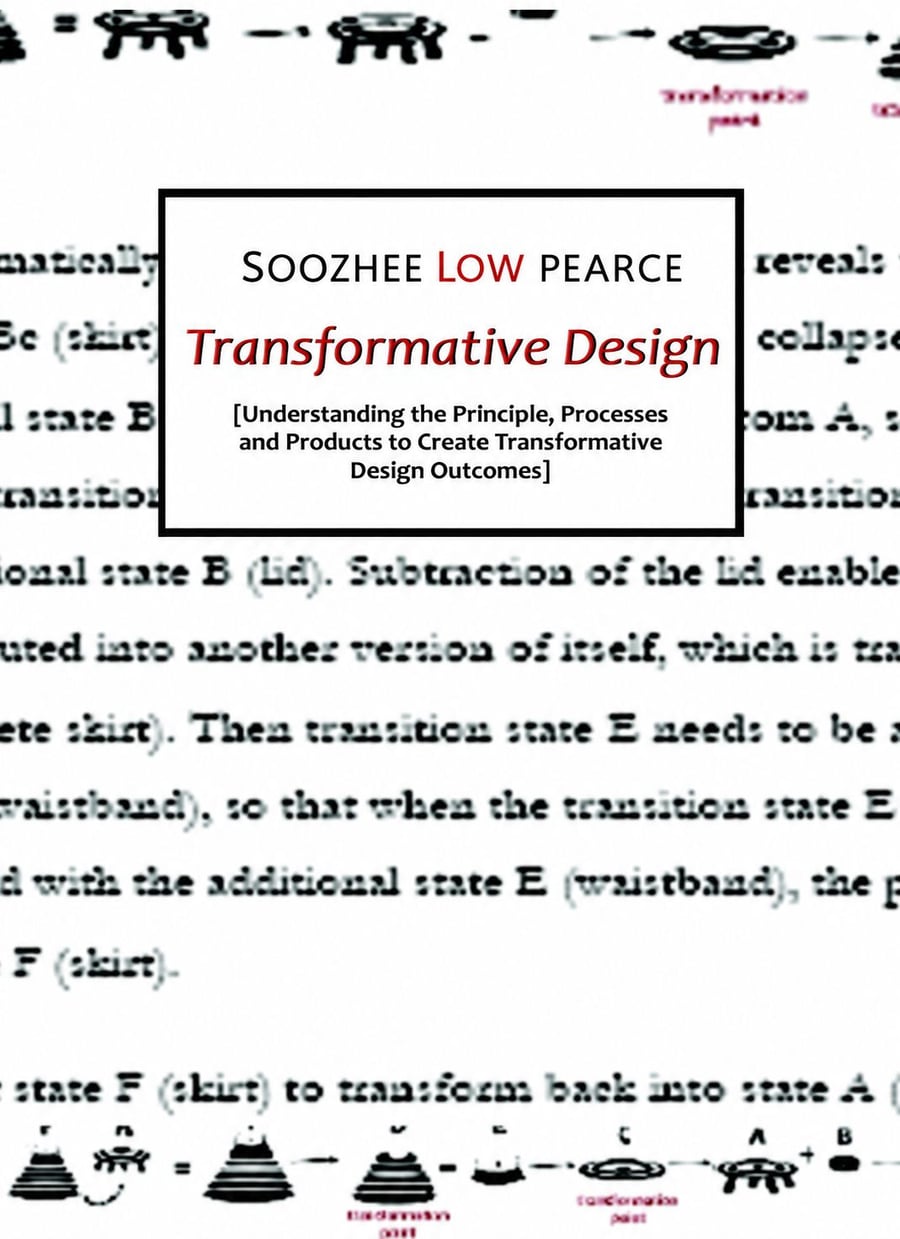
An original Master of Design thesis on the principle, processes and products that allow one defined state to become another.

The Idea
From one defined state to another
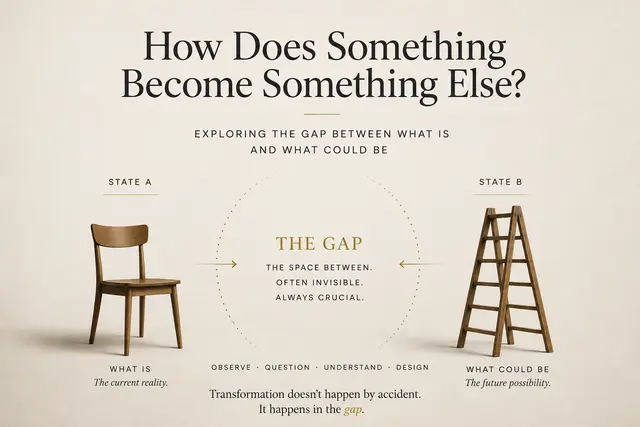
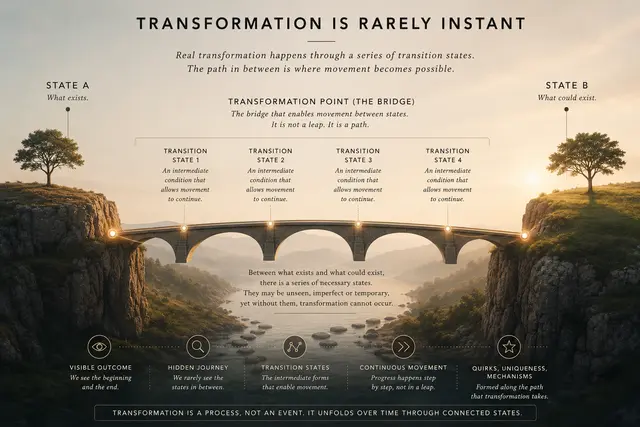
Transformation is not only an outcome. Between State A and State B lies a gap — and a bridge. The thesis studies that crossing: the Transformation Point, the transition states that make movement possible, and the physical notations that record how change holds together.
Drawn from twelve transformative products, the work names a Transformative Principle and three approaches through which cyclical change can be designed, observed and returned.
Current condition
POINT
New condition
Structure
Principle, processes, products
Three editorial divisions organise the research. Across them run three classifications of transformative change — not as colourful categories, but as ways of reading how an entity moves.
01 Principle
The Transformative Principle: cyclical change in which a single entity appears to become more than one, remaining connected across states.
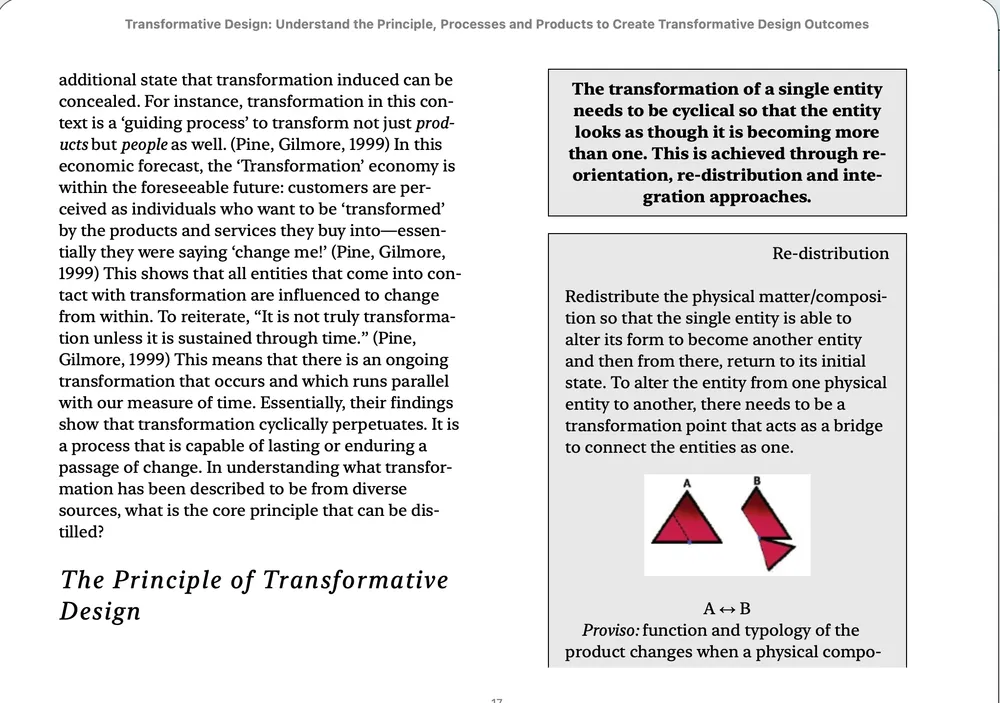
02 Processes
Steps from mental conception through physical execution — including notation for recording how State A traverses toward State B.
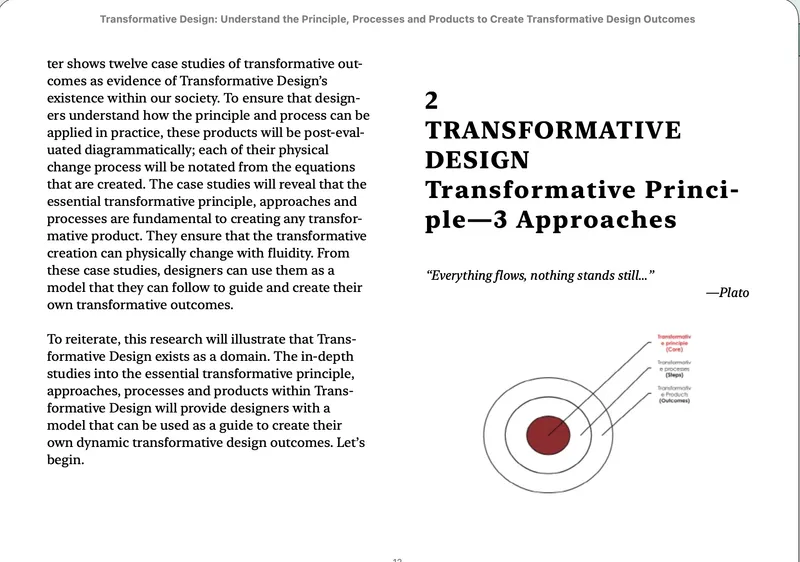
03 Products
Twelve case studies of transformative products — read through diagrammatic notation for how physical change is held and returned.
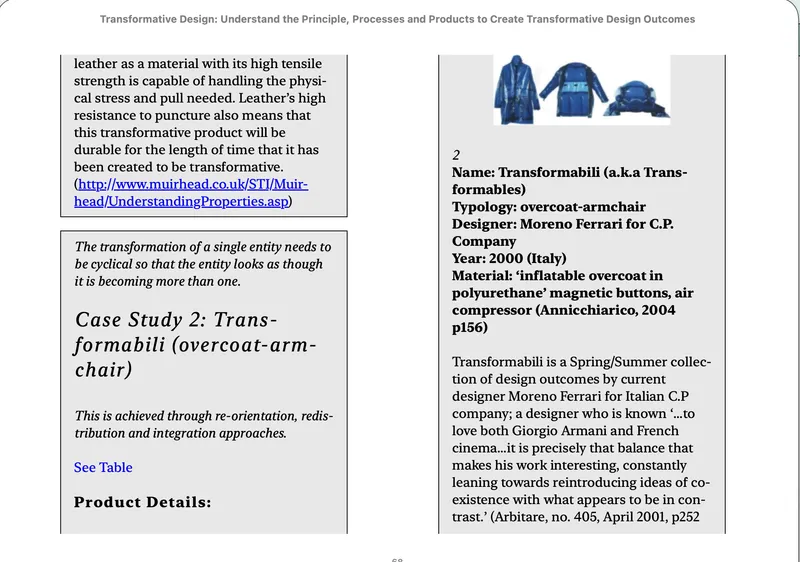
Approaches
Three ways transformation holds
Classifications of transformative change drawn from the twelve case studies — ways of reading how an entity moves between states.
-
01
Re-Orientation
Change through a shift in position, facing or alignment — the entity remains, its orientation transforms.
-
02
Re-Distribution
Change through redistribution of mass, parts or material — composition reorganised into a new state.
-
03
Integration
Change through integration of elements into a unified form — separate parts become one continuous state.
Selected Pages
Archival plates from the 2008 edition
Full thesis pages at readable scale. On larger screens, browse the strip; on mobile, one plate at a time.


Writings on Transformation
Essays from the archive
Provenance
An original Master of Design thesis, 2008
Submitted to the Faculty of Design, Architecture and Building at the University of Technology, Sydney. Written and designed by Soozhee Low Pearce. First issued as a Lulu U.S. trade hardcover edition, October 2008.
Held here within the Caelverum Archives as the original edition — principle, processes and products of transformative design, presented in their 2008 form.
- TitleTransformative Design: Understanding the Principle, Processes and Products to Create Transformative Design Outcomes
- AuthorSoozhee Low Pearce
- TypeMaster of Design by Thesis
- InstitutionUniversity of Technology, Sydney (UTS)
- FacultyDesign, Architecture and Building
- Year2008
- Pages166
- Case studies12
- ISBN978-1-4092-3957-4
- EditionOriginal
- ArchiveCaelverum Archives
The Book
The original 2008 edition
166 pages · Principles · Processes · 12 Case Studies
Buy on Amazon
- 166 pages
- 12 case studies
- Original edition (2008)
- ISBN 978-1-4092-3957-4
A study of how transformation happens — principle, process, and product.
Return to Soozhee →